Governance
Automation you can trust — because you can inspect it
Trust in automation isn't a marketing promise; it's an architectural property. These are the design rules we apply to every system we build, from a two-person salon to a mid-market operation.
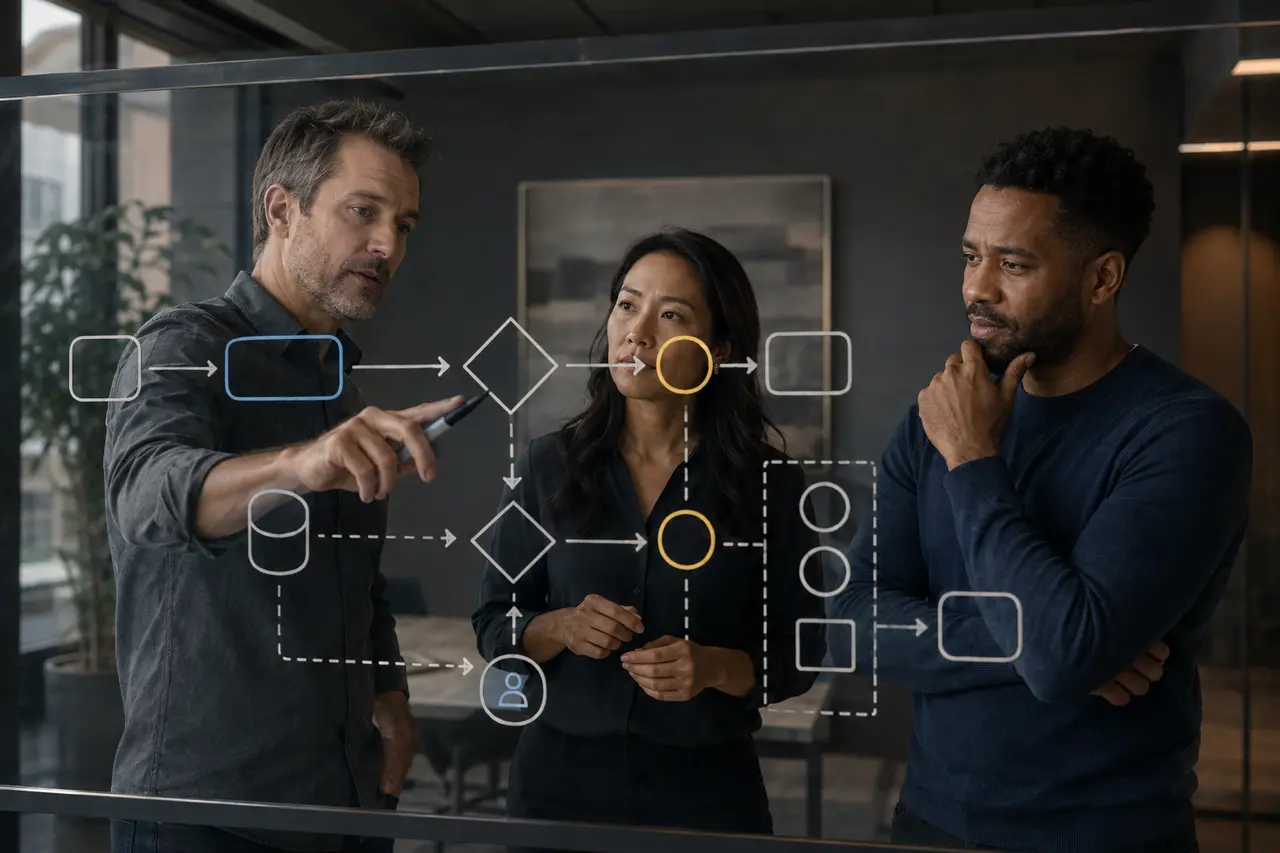
The governance pattern
AI proposes. A person approves. The system records it.
Confidence checks decide when a human sees something. Low-stakes, high-confidence work flows through; anything uncertain or consequential routes to a named person with full context.
- TriggerInput received
- LogicValidation
- AIAI proposal
- LogicConfidence check
- HumanHuman approval
- ActionAction executed
- ReportAudit log
Principles
Nine rules we build by
Human oversight by default
Anything that spends money, contacts a customer with a commitment, or changes a record of consequence passes through a person. AI drafts; humans decide.
Least-privilege access
Every integration gets the narrowest permissions that let it work. Systems are scoped so a single compromised credential can't reach everything.
Data minimization
We collect and move only the data a workflow genuinely needs. Sensitive fields stay out of automations that don't require them.
Logging and traceability
Every automated run is recorded — what triggered it, what it did, what the AI produced, and who approved it. You can reconstruct any decision later.
Validation before action
Inputs are checked before anything downstream happens, so malformed data becomes a flagged exception rather than a wrong email to a customer.
Monitoring and alerting
Failures surface to a person quickly. Silent breakage is the most expensive failure mode in automation, so we design against it explicitly.
Defined escalation paths
Every workflow knows what to do when it's uncertain: hand off to a named human, with context attached.
Secure integrations
Credentials stored in managed secret stores, encrypted transport, rotation guidance, and documented access reviews.
AI output review
Where AI writes copy, classifies documents, or answers customers, we build review surfaces and sampling routines rather than trusting output blindly.
Scope discipline
Where we deliberately don't automate
Responsible automation begins with a clear boundary. We automate the repetitive operational work around a consequential decision—not the licensed, fiduciary, or human judgment inside it.
Operating boundaries
Human authority stays visible
- 01
Healthcare and wellness
We support acquisition, scheduling, reminders, reviews, staffing, inventory, and administrative reporting. We do not build systems that make or influence clinical decisions.
- 02
Trading and finance
We build journals, risk trackers, position-sizing calculators, and performance analytics. We do not sell signals, strategies, or promises of returns.
- 03
Every industry
We decline automation where an error could harm someone and no practical review step exists. Uncertainty routes to a named human with context attached.
Saying no to the wrong scope is part of the consulting.
Your data
Handling, retention, and portability
Ownership
Your data and your systems belong to you. Accounts are created in your name where the platform allows it, and credentials are handed over at close.
Retention
We hold only what's needed for the engagement, delete working copies afterward on request, and can sign your NDA before discovery begins.
Portability
No hostage architecture. Documentation, exports, and admin access mean you can maintain, extend, or move the system without us.
Questions about governance or data handling?
Bring them to the consultation. We'd rather answer hard questions early than discover a constraint mid-build.